
The Brief
Leading from the previous task, where you were working fast to fill up a whole sketchbook, your next task is a slower observational exercise where you will be considering description as a means of teasing out the simple narrative of the scene. This will enable a jump between the observed and the authored.
Draw out four equally sized oblong or square outlines across a single or double page in one of your sketchbooks. Remember that whatever size you draw, your chosen scene will need to fit inside.
In the first box, draw some lines for yourself to write on. In the second, third and fourth box, observe the perspective of your space – the shape or horizon line of the floor and perhaps a doorway or corner) Repeat this across box 2,3 and 4.
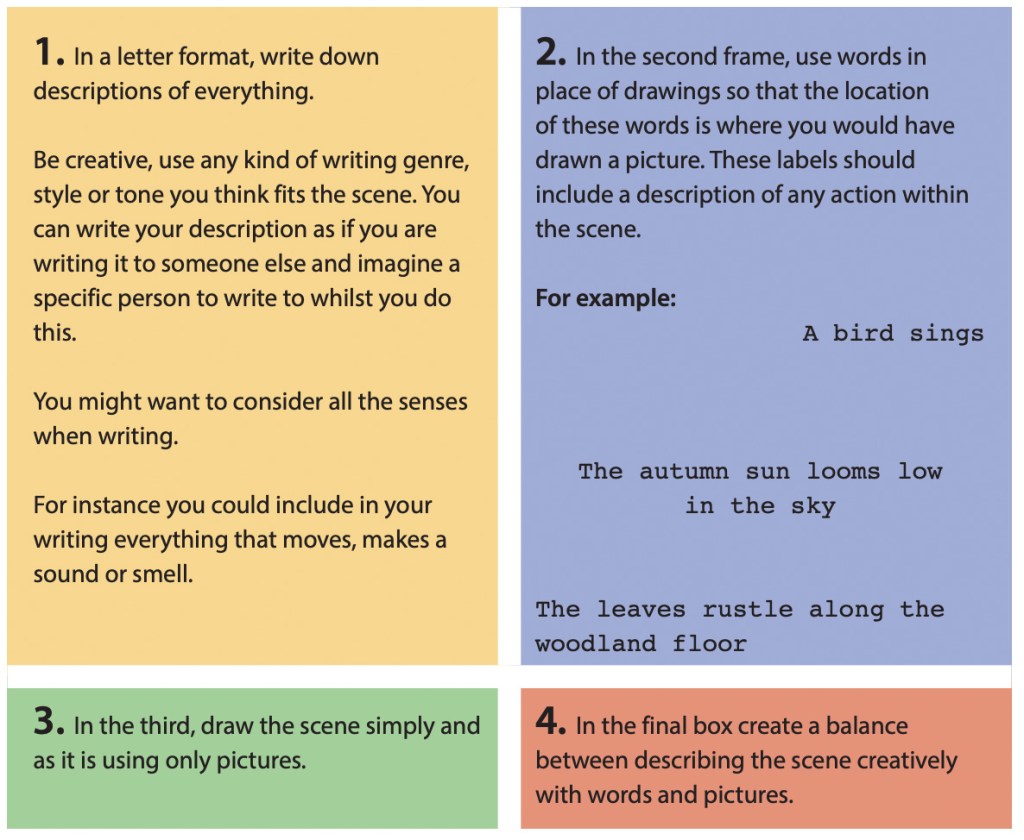
Follow the instructions in the box below:
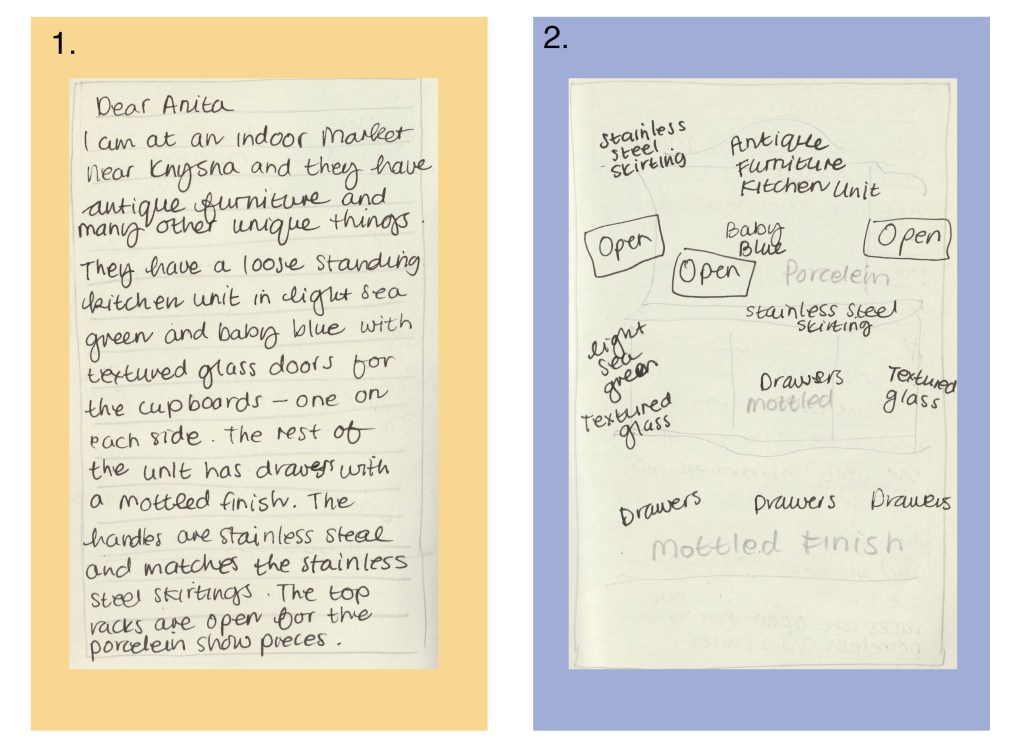
Response to the brief
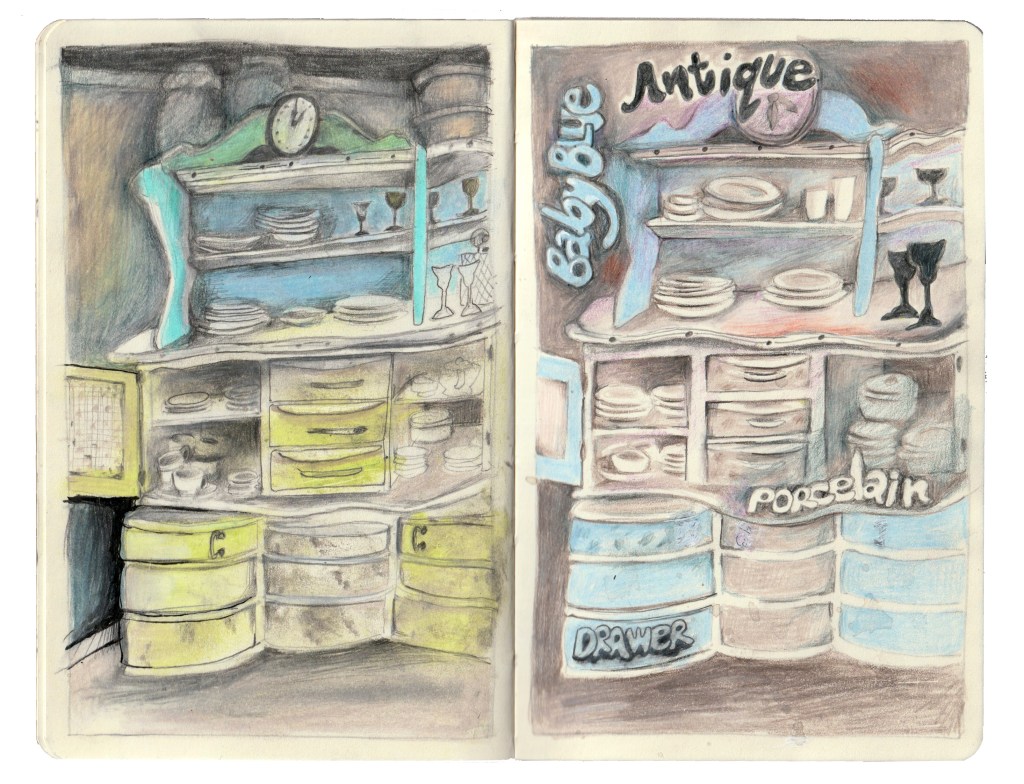
On my outing to an indoor market in the Western Cape, I encountered this loose-standing kitchen cupboard, which probably comes from the late 1800s. I have chosen this cupboard as an observational drawing for this exercise.
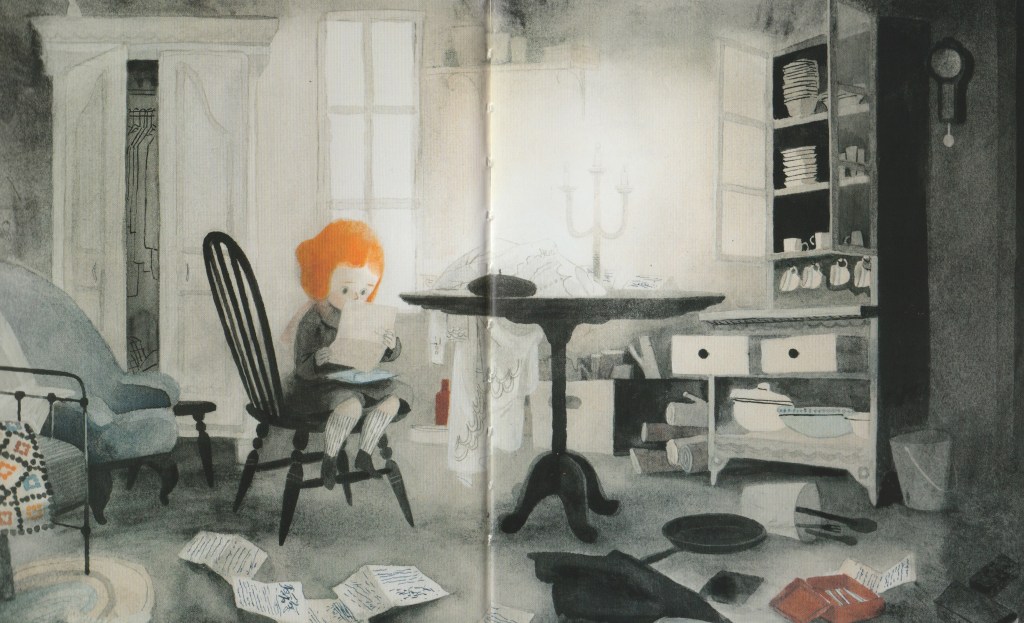
I was fascinated by the kitchen illustrated by Isabelle Arsenault in the book Captain Rosalie and would like to explore how she so beautifully depicted the kitchen cupboard in her illustration.
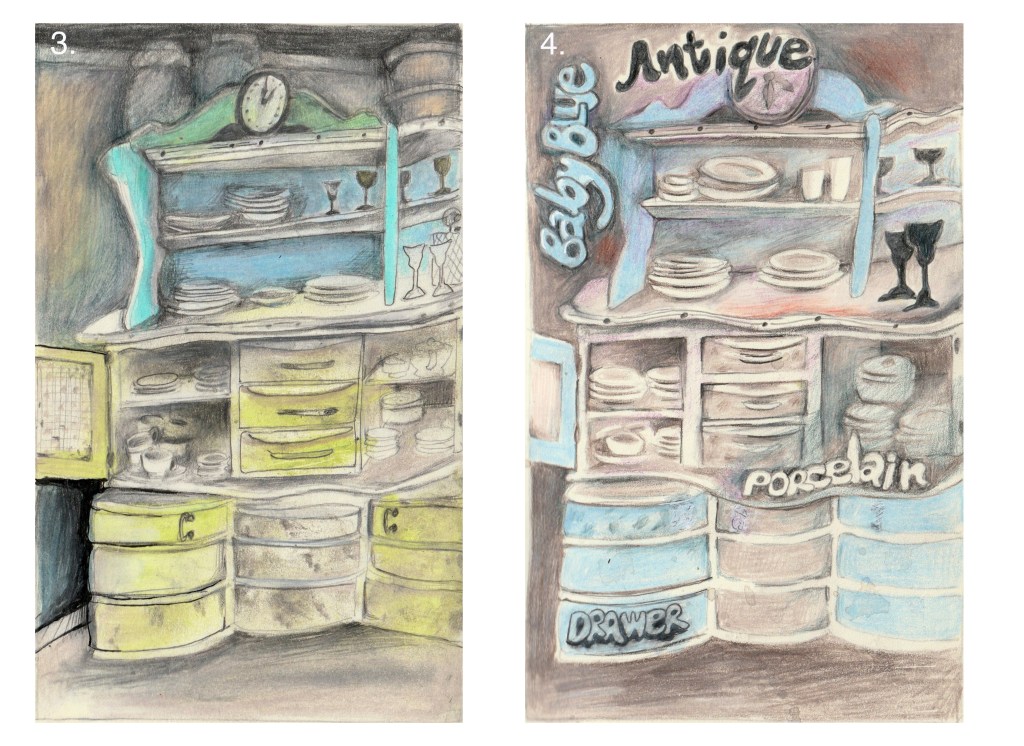
I am going to use coloured pencils to achieve an old-world, antique look with soft edges to reflect a soft, sensitive and delicate mood. These cupboards usually hold delicate porcelain crockery, which can easily break, and I would like to reflect that in the illustration.
My reflection:
Which approaches did you enjoy, and which will you take forward from this task?
I enjoyed the whole process, which made me more aware of the tactile qualities of what I was drawing by using words to describe what I was seeing to a friend.
What happened when words and images interacted; did they reinforce or play off against each other?
In this case, the words reinforced the meaning and understanding of the illustration. However, I do feel that the typography/hand-lettering could have been different sizes and perhaps also different line weights. In hindsight, I would change it and give the text a bit more thought.
Did describing the scene using words first affect the way you drew afterwards?
Yes, using the word ‘baby blue’ made me focus more on baby blue as a colour. The word ‘antique’ echoes the antique-looking rendering I have applied.
Did what you described using words help you to decide the emphasis of your image?
Most definitely. I would say the word ‘antique’ is the keyword for this illustration. Describing what you see in a few words narrows down the concept of the scene.
 Peachy Brushes