
The Introduction to Story Structures
We introduced the idea of story structure through the previous exercise, with the beginning, the middle and the end format being a well-known version of this. More complex story structure theories have been developed through studies within anthropology, psychology and literature. From as early on as Aristotle who broke down Greek dramas into six common constituent parts, to James Joyce’s suggestion of the ‘monomyth’, a singular pattern which all great stories follow, intellectuals have long been considering the ingredients of a good story.
More modern influential figures within studies of story structure include the mythologist Joseph Campbell whose 1949 book The Hero with a Thousand Faces described ‘the hero’s journey.’ This format describes a universal story where the audience follows a main character (or protagonist), coming up against a range of obstacles which must be overcome to sufficiently reach the climax of a story to enable the main character to transform into the ‘hero’.
Reading story and plot structure theories offers great deconstruction of narrative formation and this is useful for considering how you might sequence even short visual narratives to build drama, tension and interest through these common ‘story arcs.’
This research point has a focus on Nigel Watt’s Eight Point Arc structure, which draws influence from Campbell’s earlier work to create a working format useful to writers and authors to create structure within their own stories
- Consider this plot structure in your learning log.
- How might it be useful for getting more from your own drawings?
- Can you find a story which already conforms to the structure?
Considering the plot structure
As I read through the simple breakdown of Nigel Watt’s Eight Point Arc structure, the popular movie Titanic came to mind. The movie is about a non-fiction historical event, but it could be said that the main genre of the movie was a Romantic Drama, which was fictional. Using mundane real-life scenarios and adding pretend events that affect all the other events can be a great way to develop a story. There is always a cause-and-effect relationship between different events, and the timeline of stories has a beginning, middle, and end, or some writers call it, an introduction, development, and conclusion.
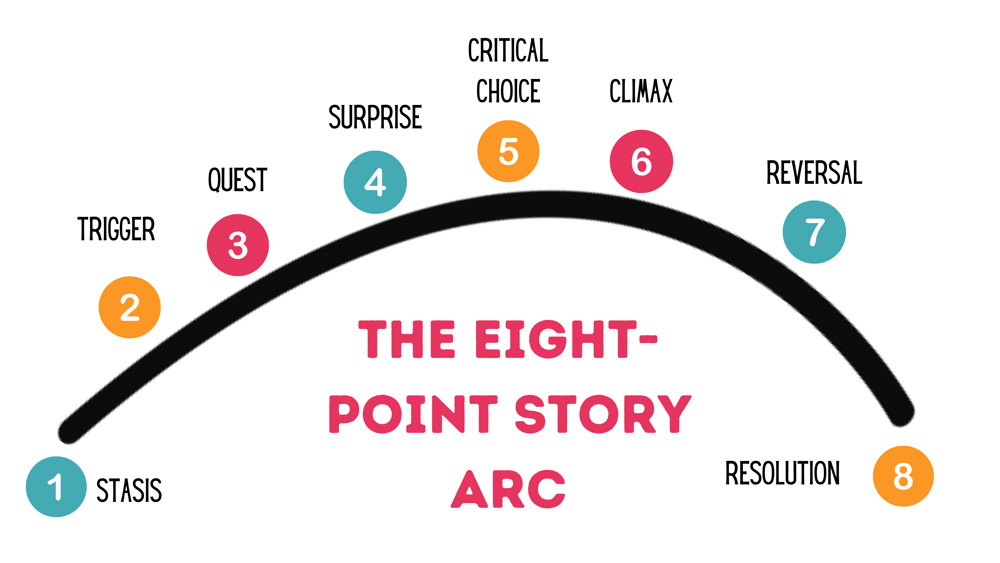
Beginning
1. Stasis – ‘normal world’ or everyday scenario: Introduce the ‘everyday’ scenario in which the story is set.
In Titanic, everybody boarded the new luxury ship. Travelling on a ship those days was an everyday scenario and nothing out of the ordinary.
2. Trigger – Provide a catalyst to start the story moving away from what is normal and fine towards a problem (something which is often beyond control)
The catalyst in the Titanic is the ship hitting an iceberg.
3. Quest – Your trigger should result in a quest…this image should define the goal of the story and add some tension.
The quest was to get off the ship on the lifeboats alive. The new couple, Rose and Jack should get off together so that they can stay together.
Middle
4. A Surprise – Introduce a turn in the story that shows the elements that might get in the way of the quest and your characters’ response. (These could include pleasant events, obstacles, complications or trouble for your hero)
The obstacle in Titanic was that Jack was handcuffed by police, and the gate was locked, which prevented the couple from getting out on the deck. Also, only women and children were allowed on the lifeboats and there
5. A critical choice/reaction – The hero makes a crucial or critical decision about how they will respond.
Jack (the hero) decided that Rose should be the one to have the best chance for survival and climb on the raft.
6. The Climax – This image should be a penultimate cliffhanger before we discover whether the quest has been a success.
This was the moment when the recovery boats were looking for survivors, and Rose had to capture their attention.
Ending
7. The Reversal – The goals have changed (the hero has been changed by the experience and has transformed)
In Titanic, the hero changed by dying. The goal was now that Rose should live a full life.
8. The Resolution – A return to a new status quo / everyday scenario.
Rose continued with her life without Jack. She got married and had children. Jack (the hero) sacrificed his life to save her, and she won’t waste this life he saved.
This same plot structure can be used in a different form, such as a zine, comic strip, or sequence of drawings without words. It can be used with any genre or content. It will be interesting to write or draw a story based on Nigel Watt’s Eight Point Arc structure.
 Peachy Brushes