
1. The Brief
For this assignment, you will be required to make and complete a full ‘foldy’ zine-style sketchbook, which develops a narrative across a minimum sequence of six stages.
Use one of the ideas you’ve played with in your sketchbook during part four as a starting point for developing this narrative. Sketchbooks you’ve created to date though out this course could be valuable at this stage.
Choose from the stages below that you were introduced to during the previous research task. You are going to build a narrative—this could be simple and everyday, or you could use the basis of the everyday to imagine a more fantastical or extraordinary sequence of images.
- Stasis
- Trigger
- Quest
- A surprise
- A critical choice / reaction
- The climax
- The Reversal
- The Resolution
Think about the approaches you have already practised and use any that might be the most useful in structuring your work for this assignment. You may decide to refer back to examples of artists who have influenced any of your approaches so far as you decide about the creative language you use to communicate.
Reflect about what you learned and enjoyed most from this part of the course and what you might use in the next section where you will choose the direction of your final assignment.
How did including written description alongside your drawing affect the way you were ‘capturing’ information?
How did you find the process of moving from descriptive drawing towards fictional narratives?
We talked about having conversations with previous illustrations; which of the illustrators mentioned in this section’s work did you have the most dialogue with?
2. My approach
I was paging through my sketchbooks from this course and had ‘conversation’ with some of the sketches to see if it can generate ideas for a story.
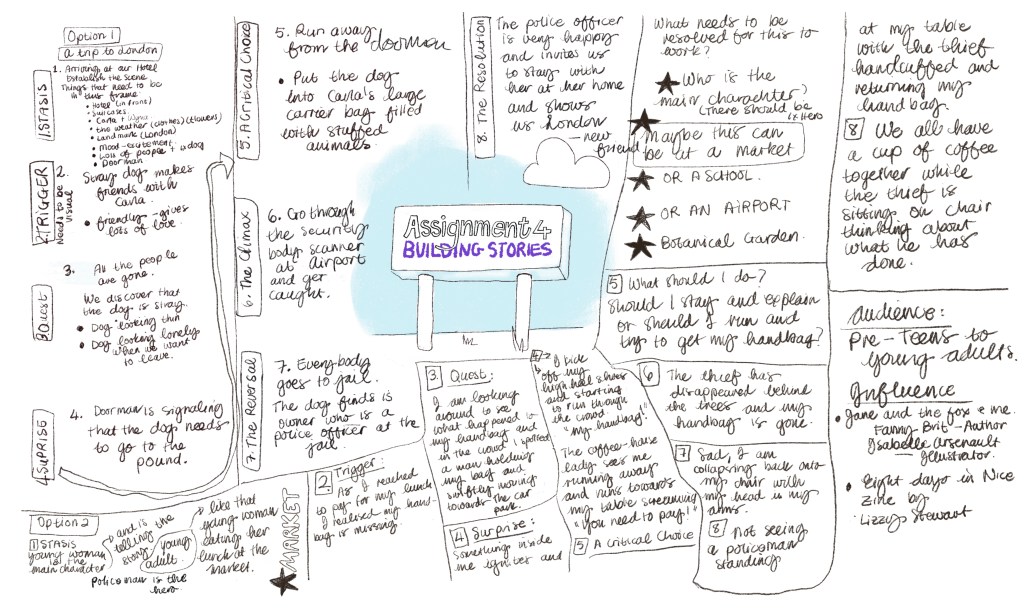
I’ve put some of these ideas together with the Eight Point Arc structure to see what I can come up with. I eventually got a story together but had to erase and rewrite it many times before the story worked with the Eight Point Arc structure. I especially struggled with the hero in the story. Should the hero of the story be the main character or can it be someone in the story? I have made the decision not to make the main character the hero in the story.
It is one thing to have the story written down, but how is it going to work in drawings with limited text? This is another challenge in itself, so I have jotted down some thumbnails to see how my first option will work as a comic strip.
2.1. Story option 1:
The first story was a travel story. I most recently travelled to Europe and have a couple of doodles in my sketchbook that I did while travelling. I didn’t have enough time to do any significant sketches, but these doodles worked well.
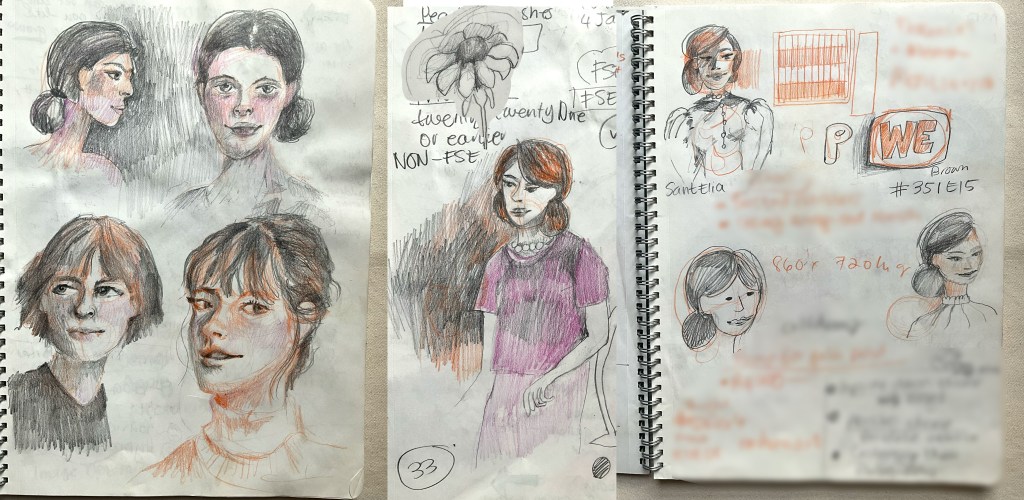
The sketches are mostly of people while I was travelling or waiting. I can still remember each scenario of each sketch and that in itself brings back many possible stories.
Once I jotted down the thumbnail composition of my first story, I came to realise that there are just too many characters that need to be in the first frame. There also needs to be a flag to show where the story is taking place, suitcases, and a doorman. As I continued drawing the thumbnails, more things emerged that needed to be tied into the drawings somehow.
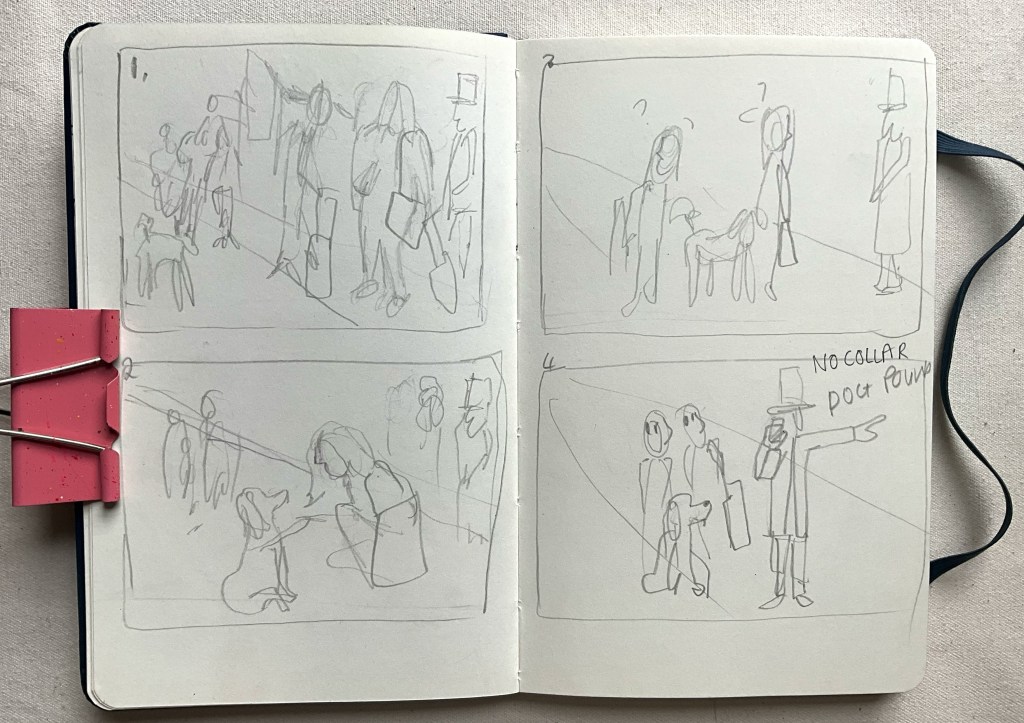
The narrative was too complicated and needed quite a lot of text to be sure that the communication to the viewer was clear and direct.
Frame 1: Arriving at our Hotel. Establish the scene. Things that need to be in this frame. Hotel, suitcases, Girl Character 1 and Girl Character 2, The Weather (Clothes and Flowers) to show it is summer, Landmark (London), Mood – Excitement, Lots of People, 1 x dog, Doorman. (Figure 3)
Frame 2: Stray dog makes friends with Girl Character 1. Friendly, gives lots of love. (Figure 3)
Frame 3: All the people are gone. Girl 1 and 2 discover that the dog is a stray. The dog looks thin and unhappy when they want to leave him. (Figure 3)
Frame 4: The doorman is signalling that the dog needs to go to the pound. (Figure 3)
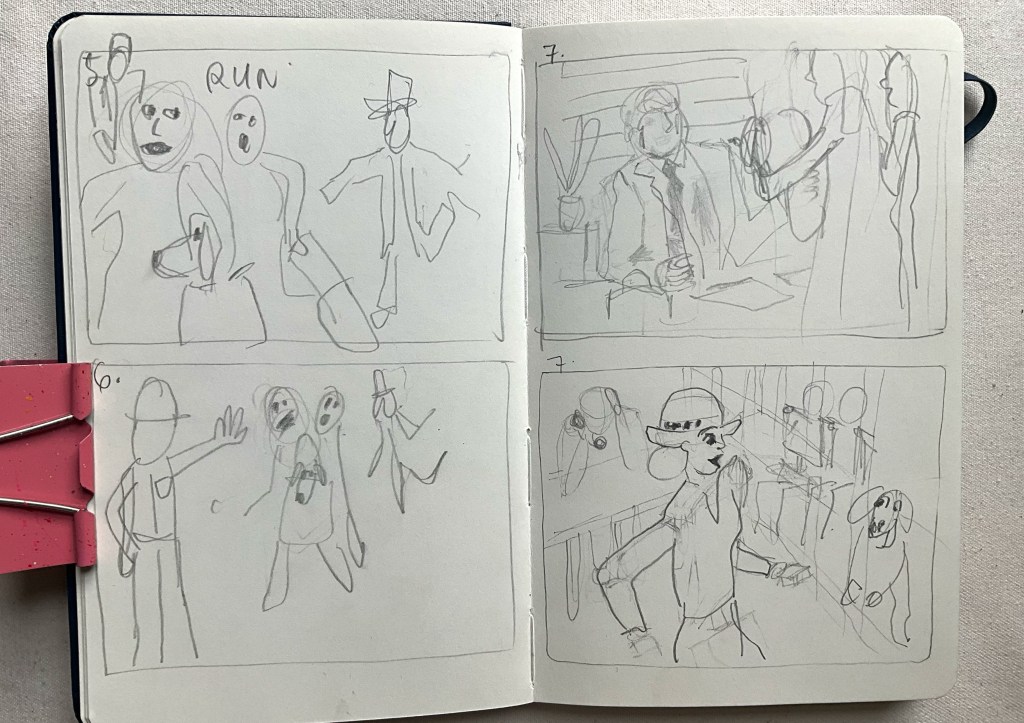
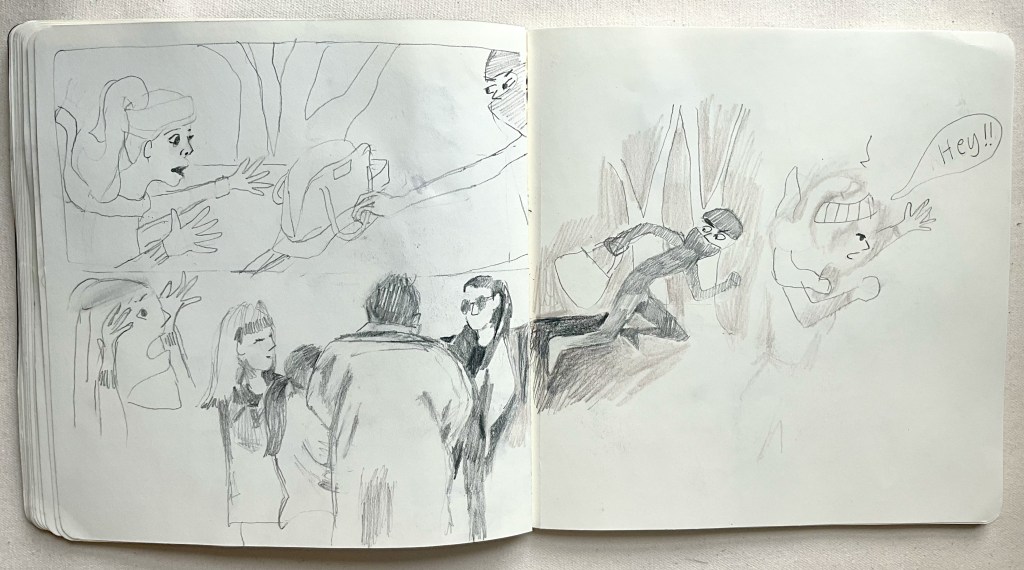
Frame 5: The girls run away from the doorman and put the dog in Girl 1’s large carrier bag filled with stuffed animals. The dog looks like it’s part of the soft toy collection. (This was too much information to depict in one frame – Figure 4).
Frame 6: The girls arrive at the airport and are going through the security body scanner at the airport and get caught for trying to ‘smuggle’ a dog through the scanner. (Yet again, too much information for one frame) – Figure 4). So I have reverted to just skipping the body scanners and have a policeman stopping the girls.
Frame 7: The girls are at the police station and need to explain themselves, but now the drama seems insignificant, compared to trying to smuggle a dog.
Frame 8: (marked as 7, but it is in the right bottom corner). The girls and the dog go to overnight jail. The female police officer comes to check on them and finds her missing dog.

Frame 9: The police officer is very happy and invites the girls to stay with her at her home and shows her gratitude by showing them around London. The story can actually continue from here with sightseeing scenes.
The story is too complicated, so I am going to explore Option 2 and keep it simple.
2.2. Story Option 2
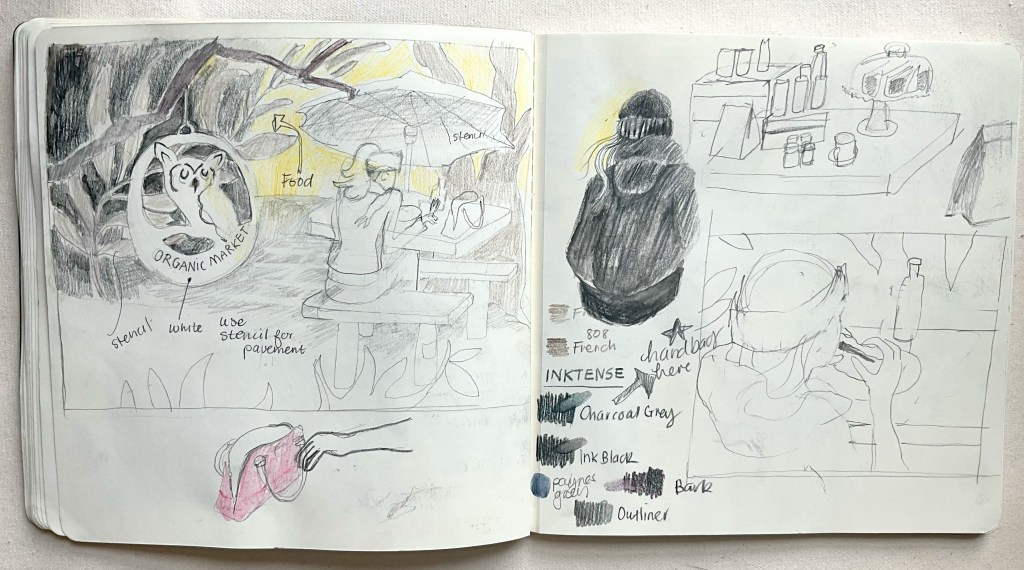
In this story, the policeman is the hero and not the main character. It turned out to be the typical damsel in distress story. I am using the sketches from the Organic Market as a starting point.
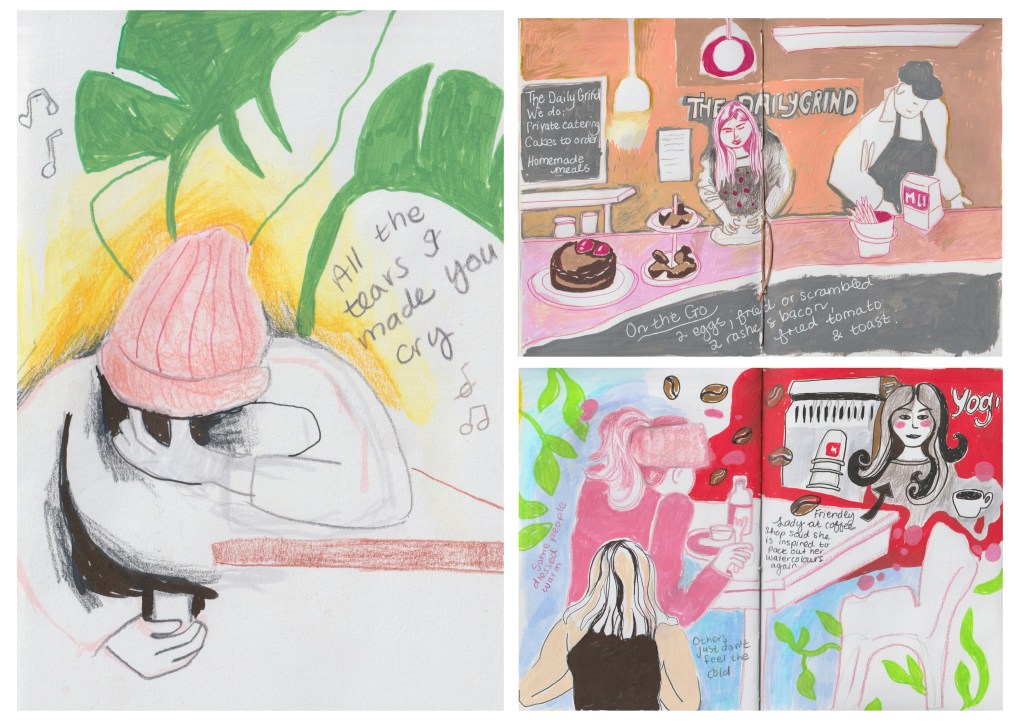
When I was drawing the young lady in pink, I wondered if she was on her way to work. She looked in a hurry, cold, and almost as if she should not be there, as if she was running late. I am going to use her as my main character.
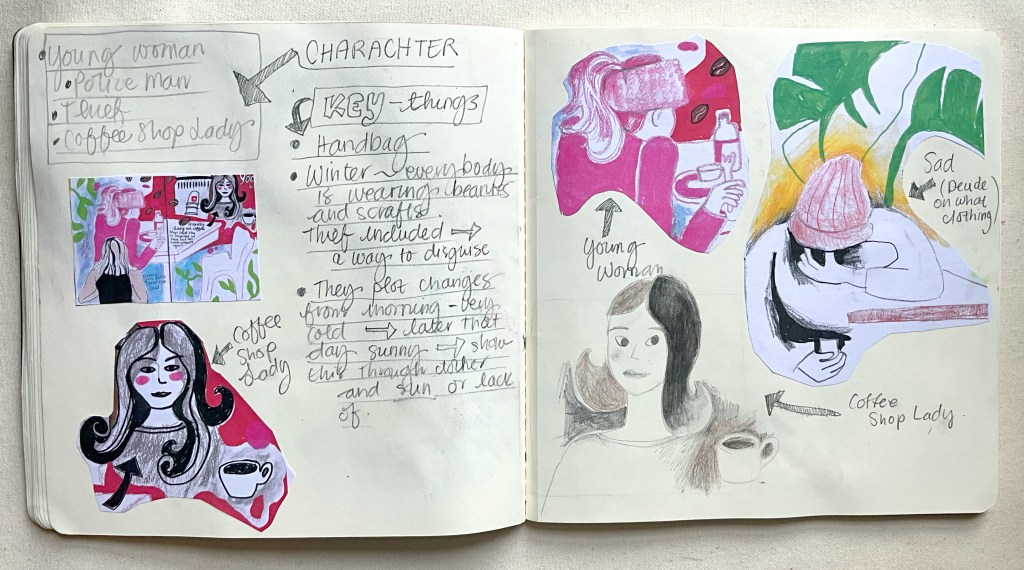
There was also a coffee shop lady that day who was very interested in my drawings. I have decided to use her as a character as well, but in this story, she is going to be mean, so there could be drama in the story. I have planned out my drawing in writing beforehand, as seen in Figure 1.
The audience will be pre-teens. I paged through the book Jane and the Fox & Me by Fanny Brit and illustrated by Isabelle Arsenault to get ideas. I also looked through Eight Days in Nice Zine by Lizzy Stewart.

Once I had a few of my characters, I moved over to my iPad to explore how I would structure the drawings in a zine format. I will use a 1 x A2 sheet of 130g/m² Smooth Cartridge Paper to fold the booklet. The paper cannot be too thick as I need to fold it easily without the foldy becoming too bulky.
I then collected visual research on police uniforms, photos in my library of different areas in the Organic Market and handbags, cars, etc.
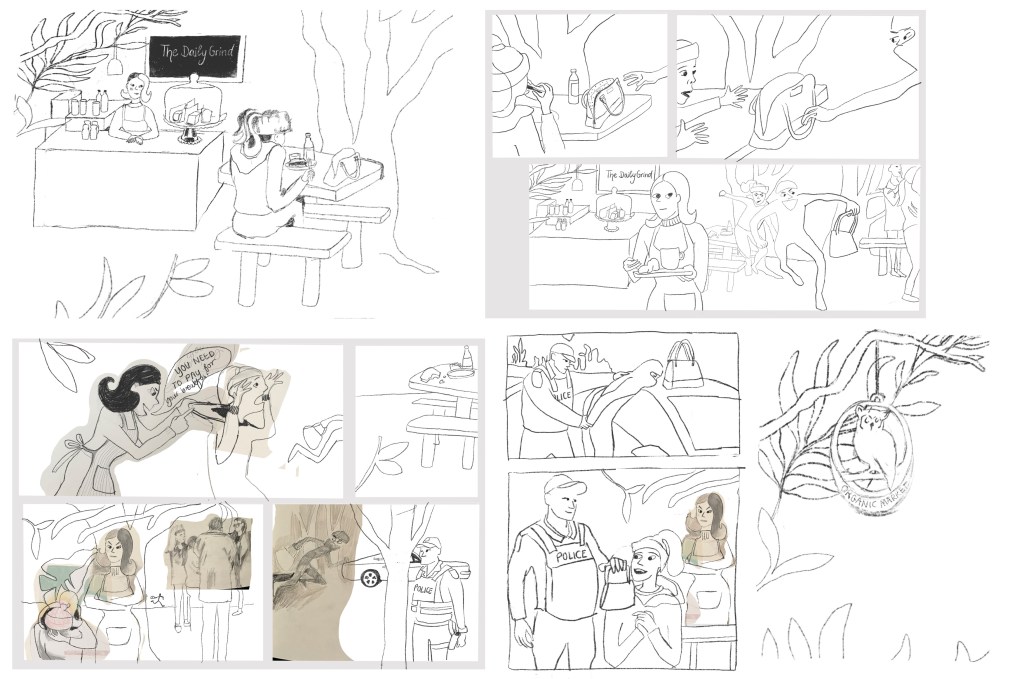
3. Finished Foldy
I planned the story to only use text where it was needed. This gives me more space for drawing and creating a story that could be interpreted by the reader. However, if I do this project again, I will explore using more text, which will allow me to create a richer story.
3.1. Frame 1 (The Cover)
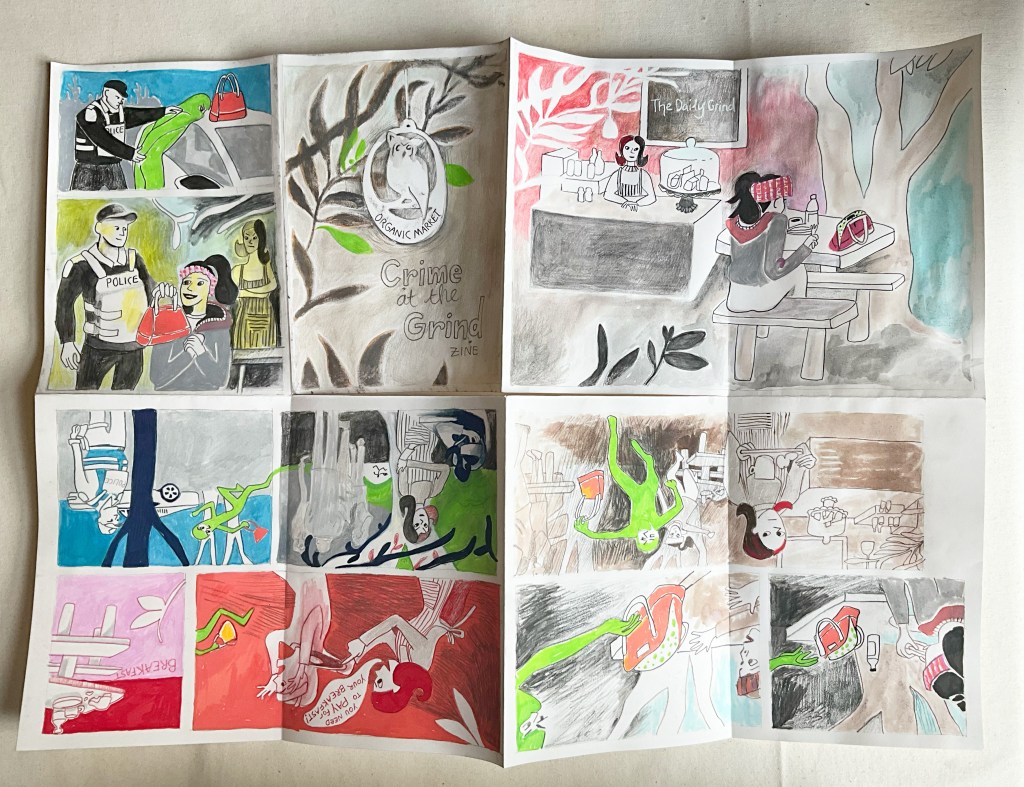
The organic market’s emblem is an owl. I have decided to use the emblem on the cover to state the zine’s location. The zine’s name is Crime at the Grind, meaning that crime happened at the coffee shop, The Daily Grind.
I opted for organic colours and a sepia look to emphasise the organic, natural look and feel of the Organic Market. However, the owl can create a feeling of nighttime, which is not what I want to go for, so I kept the cover very light with lots of texture and subtle tones. I used coloured pencil, watercolour ink, and charcoal.

3.2. Frame 2 (Spread 1)
The main character is a young woman, and the story is told from her perspective. She is eating her breakfast at the Organic Market. According to the Eight Point Arc Structure, Frame 2 and the cover are the STASIS (1), the ‘normal’ world of everyday scenarios.
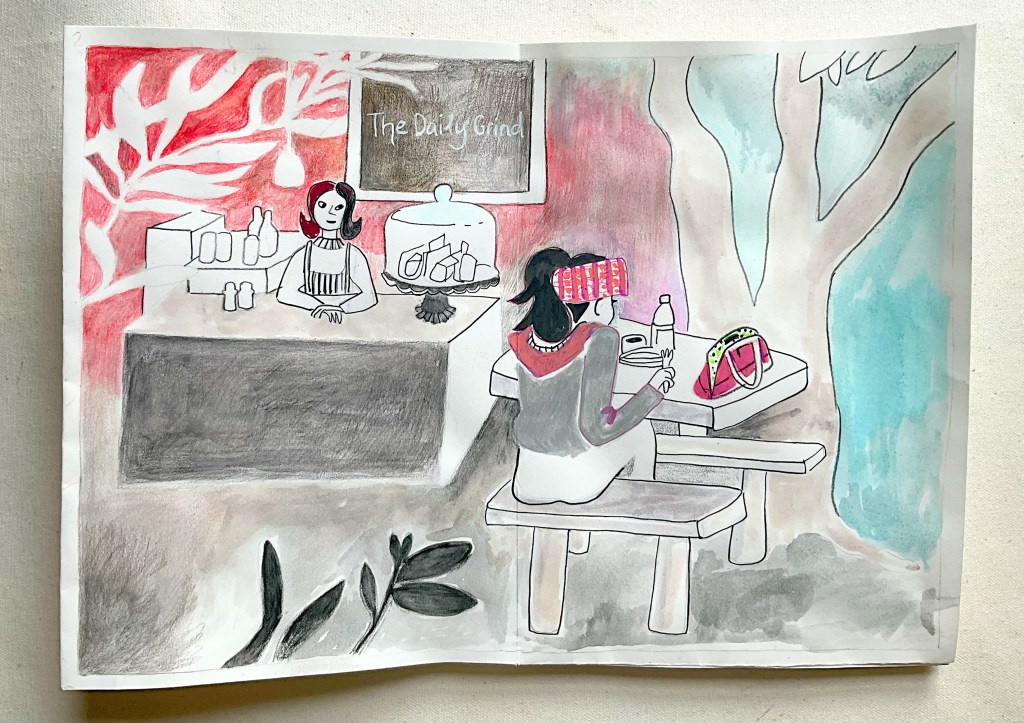
I created the establishing scene over two pages to set the tone of the Organic Market. I used lots of earthy textures and balanced them out with bright colours.
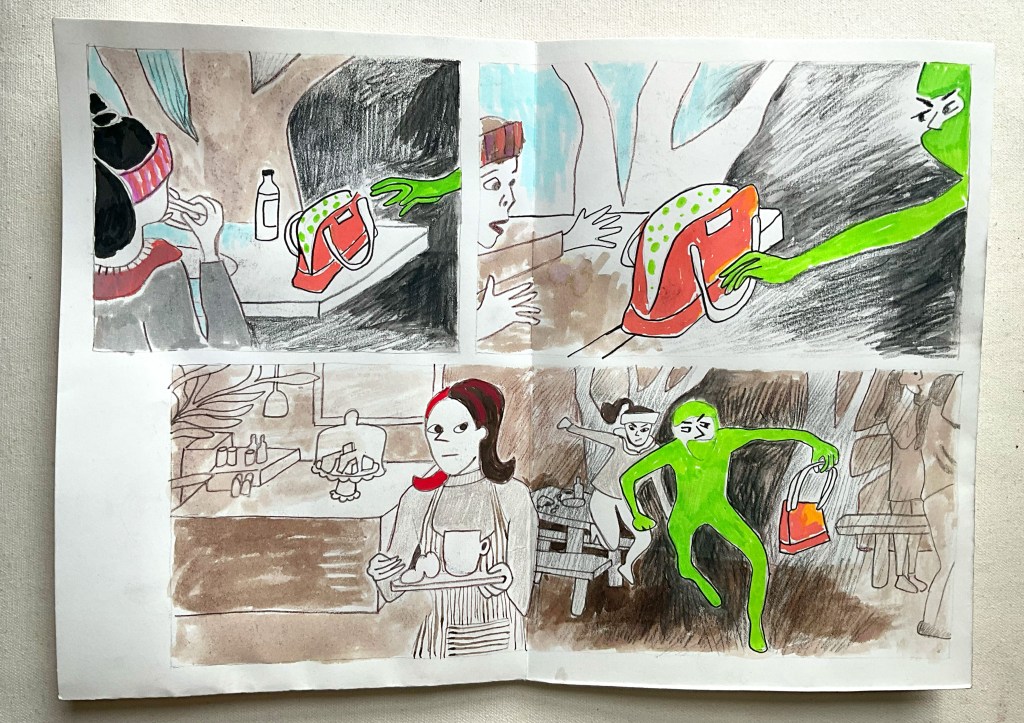
3.3. Frames 3, 4 and 5 – (Spread 2)
In spread 2, all the action is happening, so I have split the double page into three frames to create an energetic appearance. The TRIGGER (2) is the thief who is stealing the handbag, creating a problem that needs to be solved.
3.4. Frame 6, 7, 8 and 9 – (Spread 3)
The trigger resulted in a QUEST (3) which started in Frame 5 with the young woman jumping up and chasing the thief. The coffee shop lady is only concerned with her own matters and doesn’t show any sympathy while observing the scenario.
In Frame 6, she grabs the young lady by her hoodie as if she is running away and says, “You need to pay for your breakfast!” This is the surprise (4) that might get in the way of the quest to catch the thief and get her handbag back.
Frame 7 is an insert of her breakfast.
In Frame 8, she is sad, and she makes the decision to stay at the coffee shop instead of running after the thief. The coffee shop lady likes to see her being miserable. This is the CRITICAL CHOICE (5) in the Eight Point Arc Structure.
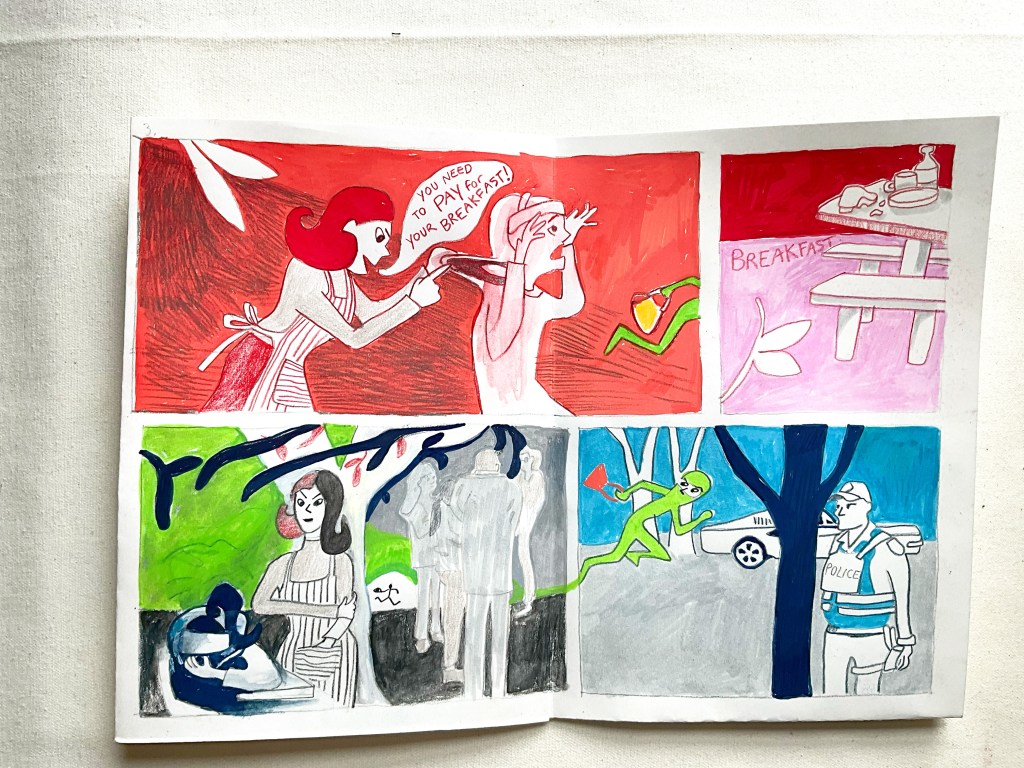
In Frame 9, we see the policeman standing behind the tree. The thief is unaware of this obstruction. This is the CLIMAX (6), the cliffhanger before we discover whether the quest has been a success.
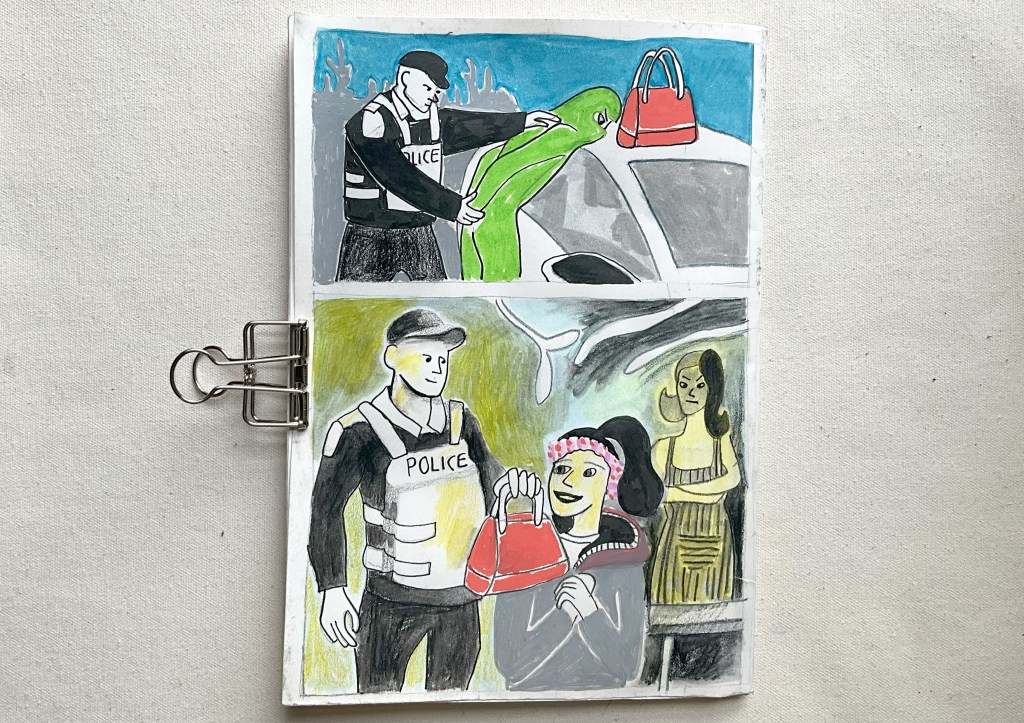
3.5. Back Cover (Frames 10 and 11)
In THE REVERSAL (7), the goal has changed from the young woman wanting to catch the thief to the police officer capturing the thief. The young woman has been changed by the experience, her mood changing from sad to happy. In Frame 11, there is a return to everyday scenario; the order is restored. THE RESOLUTION (8).
4. Fabulous Foldy
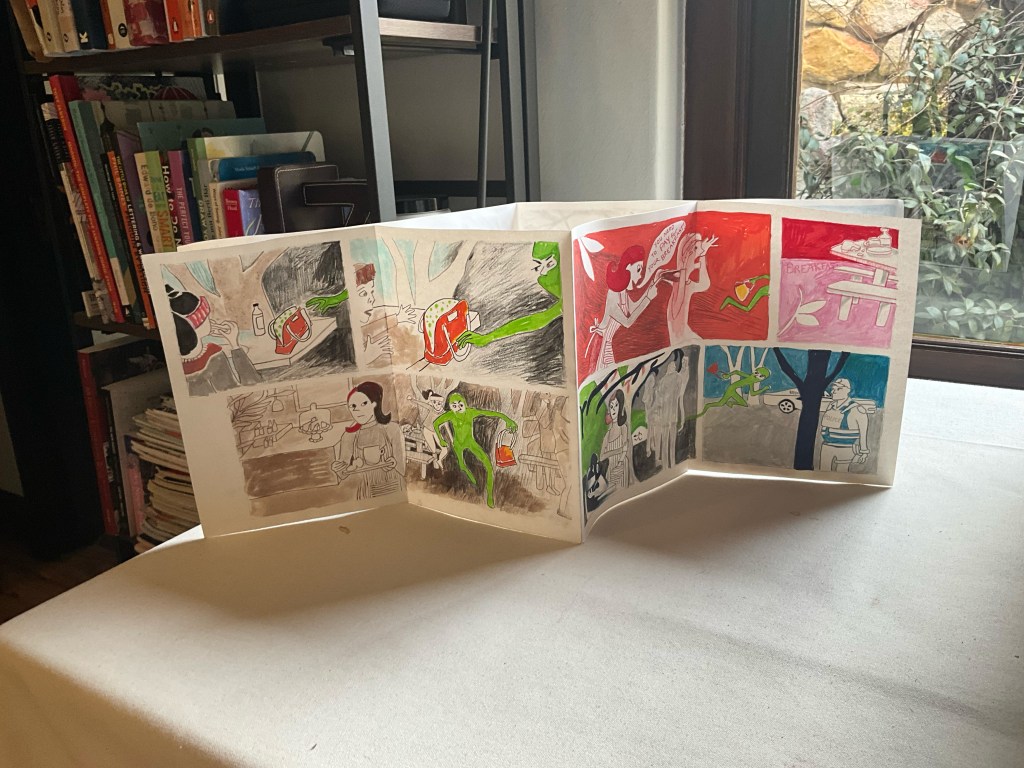
Even though we made a foldy at the beginning of this unit, I rediscovered how great this simple structure works as a sketchbook. It was lovely to work with a bigger foldy, and I will use a foldy again because it is easy to lay flat, and you can choose any paper of your choice. It is just big enough to fill up when drawing on location.

5. Reflection
I enjoyed Conversation with Pictures the most in this course. It is a great way to think beyond the obvious. It was also a refreshing experience to “Fill up your Sketchbook while going out to sketch and observe.
Researching all the different illustrators in ‘Top Ten Visual Diaries’ was very inspiring, and I have added new favourites to my list. The Storyboarding exercise has given me new ideas for different perspectives and angles.
I will use all these tools going forward.
The final assignment was challenging, but growth is not possible without a struggle, so I am pleased to have learned new things.
 Peachy Brushes