
The Brief
Find a way to assemble what you’ve now gathered to make a visual journal that is a memory store of the exercises and activities you have most enjoyed and the experiences that have been most important to you. Integrate this with the action plan and combine drawings and words that might serve as a reminder of what you want to do more of.
Be inventive and resourceful. Try new ways of connecting the drawings and integrating your plan to create a sketchbook that is a visual journal that documents your experience to date, feeding back on your discoveries and feeding forward into the final assignment.
Don’t be precious – it might be rough at the edges. Make sure this feels like your book – a journal that is a snapshot summary of where you are at this stage of the course and where you want to go next in your learning journey.
Responding to the brief
I mentioned in ‘Exercise 5.0 Taking Stock’ that I would like to revisit Dr. Emma Powell’s sketchbook. In this exercise, I will attempt to take apart completed sketchbooks, mix them up, and sequence them together in a large A3 sketchbook.
Going forward, this will create a space where I can add to a collection I have created, for instance. I have gathered all the kitchen-related sketches together. Whenever I collect more visual material that has anything to do with food or a kitchen, it can be added to this collection.
I have also included ‘Fill it up FAST’ and ‘Assignment 4 Building Stories’. As I might be doing Option One: ‘The Kitchen, ’ I have collected the visuals from my sketchbooks related to the kitchen theme.
Making the book
The design of the book should lend itself to easily adding sections in the book. I have given the book much thought and paged through several book designs and came to the conclusion that a lever arch file is going to work the best.
But I don’t want a regular lever arch file where I punch holes in my artwork and ‘file’ it. So, I have thought of creating a long strip tab, half of which is covered in fabric to give it extra durability. The other half is a paper tab for attaching visual material.
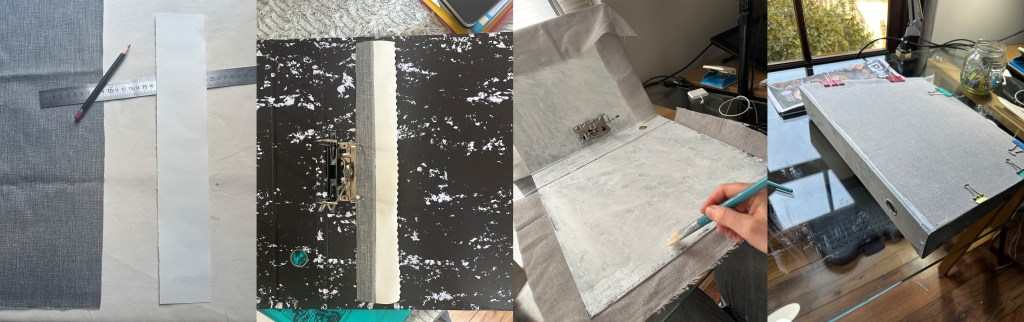
The book will grow as I add more sketches and visual finds to the collection or theme. Visual material can be added by attaching an envelope or a folded compartment to one of the tabs. I have been experimenting with paper clips, removable glue dots, and clips to keep everything together, but the best way is to add a paper backing of your choice and clip or temporarily paste the visual material to the page. This can also be stitched or tied.
Below I have included a video where I will demonstrate how this book works.
Reflection
Overall, my idea worked well for now. Surely, I will improve it the more I work with the visual diary. My only concern when taking my completed sketchbooks apart is that many drawings made across the two pages where breaking up in two sections.
Going forward, I would rather work on loose pieces of paper and foldies, which will be easy to insert unless I deliberately want to break up the double-page drawings.
It will take some time to get used to having all my drawings and visual diary in one place, but I am excited to start working this way.
 Peachy Brushes
wow!! 28Assignment 5: Application and Context
LikeLike